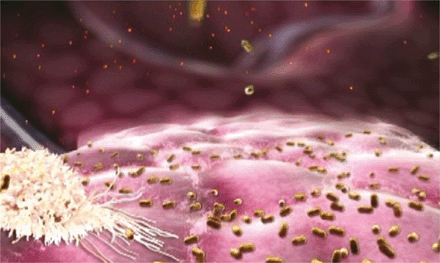
I had the privilege of working this past summer at IBM Research Cambridge in the Visual Communication group with Martin Wattenberg and Fernanda Viégas. Having watched them and the rest of the team prepare this project, it's exhilarating to see it launched! We also spent time researching and testing additional features to support social data analysis. Look for our upcoming CHI2007 paper (link soon) for more!
]]>
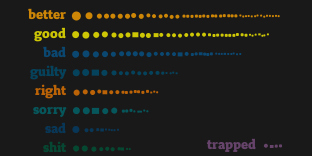
The net-art project We Feel Fine attempts to answer some of these questions through a set of playful yet ambitious visualizations backed by data scraped from thousands of blogs.
For those of a more dichotomous temperament, the same data stream is used to power Lovelines, an interactive exploration of statements of love, hate, and everything in between.
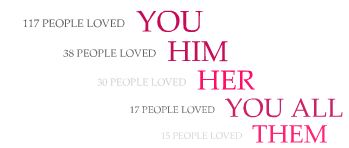
The projects were created by my friend Sep Kamvar and his collaborator Jonathan Harris (also responsible for the Webby-winning 10x10 and WordCount visualizations). Should you have any related ideas of your own, the two have made the results of their continual blog-crawling available to all in the form of a public web API.
]]>
I have camera phone photos of the blaze both before and after. I don't know if the cause has been determined. I'll have to check the papers tomorrow...
]]>
This brief ZDNet article mentions some of the wonderful large display work at microsoft research, but the article of course neglects to mention the issue of seams. With multiple monitors, lines/curves become discontinuous, and what should be single elements get chopped up into pieces. This wreaks a bit of havoc with gestalt perception and in my opinion decreases the aesthetic experience of the interface.
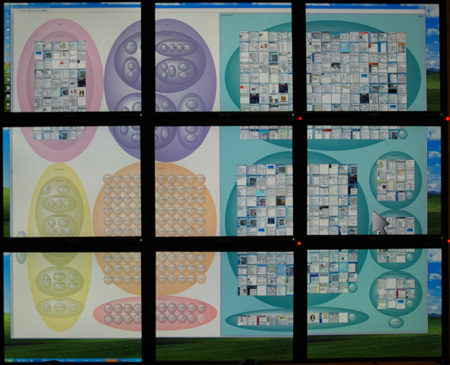
What are the solutions? Large displays without seams is one (and microsoft and others are already working on this). For today's consumers, a reasonable stop-gap may be to make interfaces seam-aware, allowing layout and presentation of interfaces to take seams into account (e.g., excel spreadsheet cells could automatically realign to improve readability across monitors). Jock Mackinlay and I devised one approach to building seam-awareness into interfaces, though things being what they are, I don't expect to see it on desktops anytime soon :)
]]>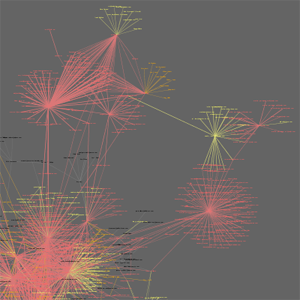 Our first design iteration (v1::white) of a visualization of the Enron e-mail corpus was recently posted on boingboing!
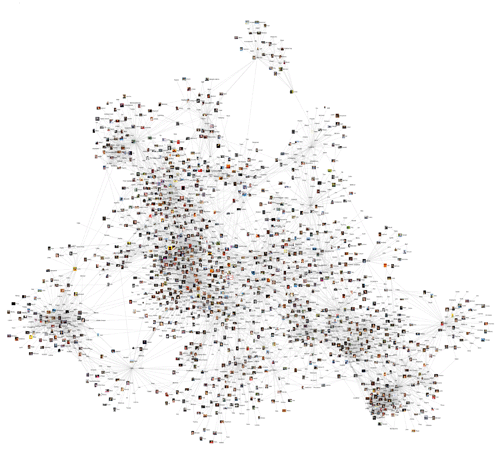
Our second design iteration (v2::grey, with temporal filtering and search) was just presented last week at a great e-mail visualization workshop hosted at the University of Maryland by Ben Shneiderman, Adam Perer, and Douglas Oard. Check it out...
 ]]>
]]>